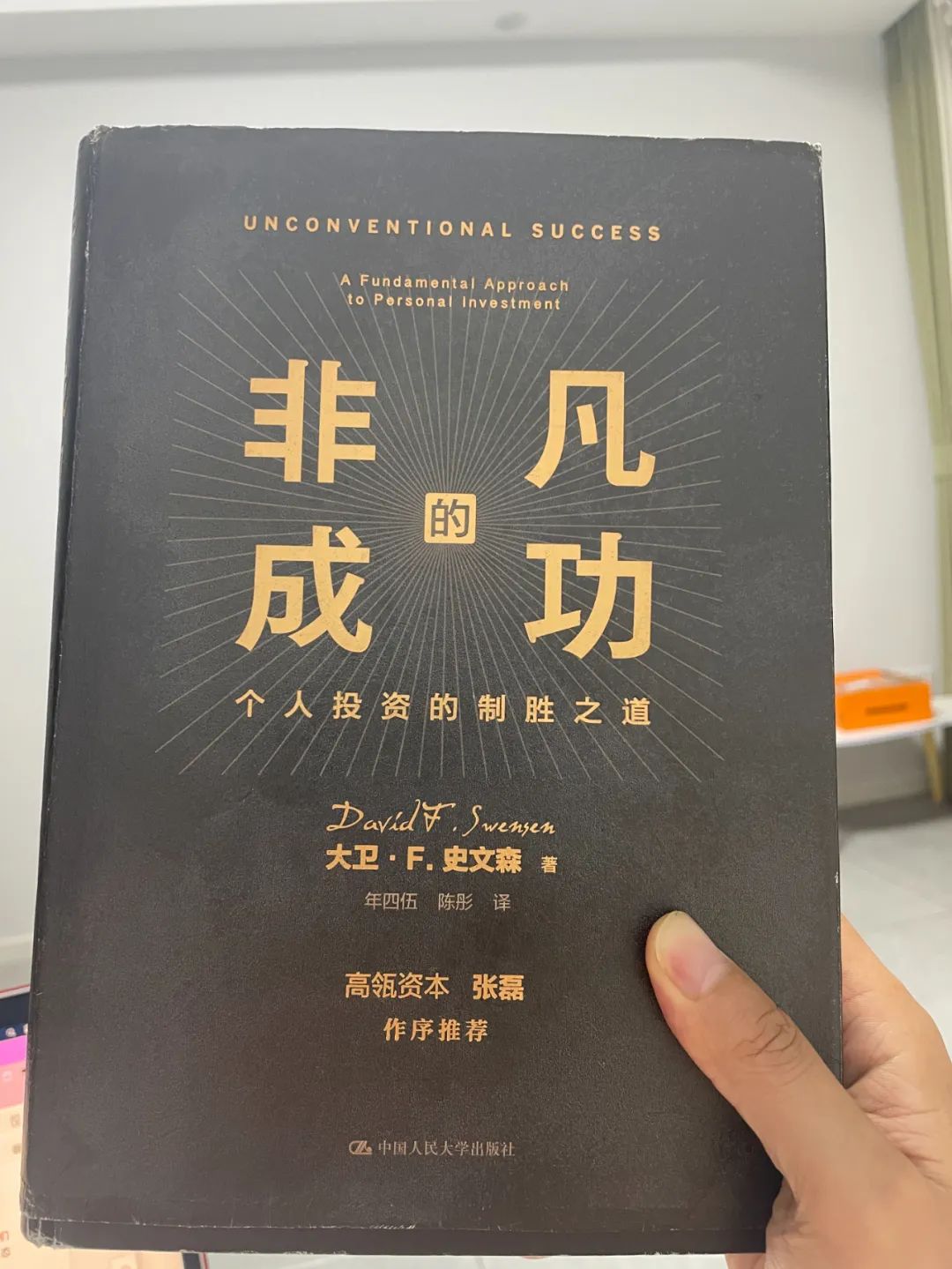
Unconventional Success: A Winning Approach to Personal Investment
- My rating: 7 / 10
- Purchase Link
This book is written by David F. Swensen and recommended in a preface by Zhang Lei of Hillhouse Capital. From his perspective as the head of the Yale University endowment fund, the author shares his experience of achieving a long-term annualized return of nearly 17%. The book emphasizes the importance of asset allocation, proposing a diversified, passively managed, and equity-oriented investment portfolio strategy.
What I Liked 🔗︎
- Clear Core Philosophy: The book clearly states that asset allocation is the core of investment, advising against market timing and security selection, and reducing the frequency of trades.
- High Practicality: It provides specific asset allocation ratio recommendations (e.g., 30% domestic stocks, 20% real estate), offering practical guidance for investors.
- International Perspective: It covers not only the U.S. market but also investment tools in global markets (like the Nasdaq index, Nikkei 225 ETF), broadening the investment horizon.
- Combination of Theory and Practice: By analyzing the characteristics of different asset classes (such as bonds, stocks, real estate), it helps readers understand how to build a diversified investment portfolio.
What I Disliked 🔗︎
- Some Content Not Fully Applicable to Chinese Investors: The asset allocation ratios and tools recommended in the book are primarily based on the U.S. market, which has certain limitations for the practical operations of Chinese investors.
- Lack of In-depth Case Studies: Although some specific investment tools are mentioned, it does not provide detailed case studies or practical implementation steps.
- Limited Discussion on Non-Core Assets: Emerging asset classes like cryptocurrencies and options are only briefly mentioned, without in-depth exploration of their risks and opportunities.
Key Takeaways 🔗︎
- Definition of Core Assets:
- Core assets are asset classes that can provide stable returns over the long term, including domestic stocks, foreign developed market stocks, emerging market stocks, real estate, government bonds, and inflation-protected bonds.
- The recommended asset allocation is:
- Domestic Stocks: 30%
- Foreign Developed Market Stocks: 15%
- Emerging Market Stocks: 5%
- Real Estate: 20%
- U.S. Treasury Bonds: 15%
- Inflation-Protected Bonds: 15%
- The Importance of Asset Allocation:
- Asset allocation is the primary source of investment returns; it requires maintaining a reasonable balance and diversification.
- Avoid active market timing and security selection, as buying high and selling low is a common mistake. One should adhere to buying low and selling high to maintain constant asset allocation ratios.
- Principles of Stock Investment:
- Security selection is not recommended for average investors because it is often a negative-sum game, with returns falling below the market average after deducting fees.
- One can choose broad-based index funds (like CSI 300 ETF, S&P 500 VOO) or stocks of high-quality companies (such as Microsoft, Tesla, Moutai, Tencent).
- Key Points of Bond Investment:
- When interest rates rise, bond prices fall; when interest rates fall, bond prices rise.
- Chinese investors can purchase government bonds or bond products available on major banking apps.
- Real Estate Investment:
- Renting out commercial real estate can generate a steady stream of cash flow, but it requires the individual’s ability to identify good locations.
- Inflation-Protected Bonds:
- There is no direct equivalent product in the domestic market. One can consider U.S. Treasury Inflation-Protected Securities (TIPS) related ETFs (with a 0.04% fee) or gold-related investments (physical gold, gold mining stocks, gold ETFs).
- Diversified Investment Strategy:
- Diversification is key to reducing risk; avoid over-concentration in any single asset class.
- An equity-oriented portfolio typically yields higher returns than bonds and cash, but one must be mindful of the risk of a stock market crash.
- Risks of Non-Core Assets:
- Cryptocurrencies (like Bitcoin, Ethereum), arms dealer stocks (like LMT), and technology sector ETFs (like XLK) are not considered core assets and carry significant risk.
- Areas like insurance and options trading are complex and require cautious participation.
- Core Asset Choices for Chinese Investors:
- Domestic Stocks: CSI 300 ETF, stocks of high-quality companies (like Moutai, Tencent).
- Foreign Markets: Nasdaq Index (QQQ), S&P 500 (VOO), Nikkei 225 ETF, etc.
- Real Estate: Renting out commercial properties.
- Gold: Physical gold, gold ETFs, or gold mining stocks.
- The Path to Successful Personal Investing:
- Implement a diversified, passively managed, equity-oriented investment portfolio.
- Abandon actively managed funds and choose passively managed index funds with low taxes and low management fees.
- Adhere to long-term investing and avoid frequent trading.
New articles on AI agents, full-stack engineering, and a one-person company
I email new writing about AI and agents, full-stack engineering, and building a one-person company. No spam, and you can unsubscribe anytime.