Notes on Introduction to Accounting and Finance
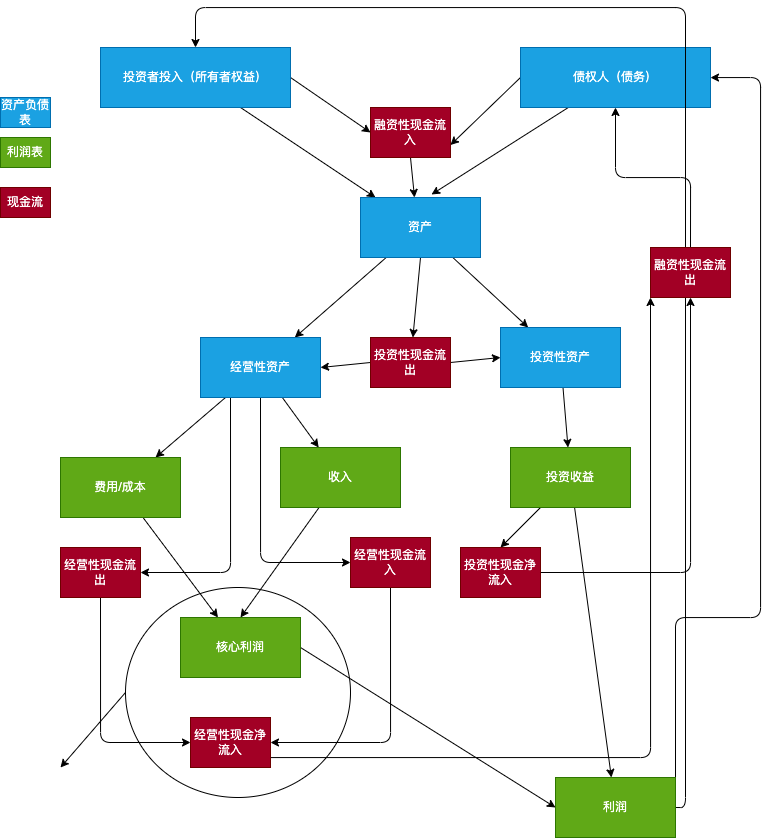
1. Simple Overview 🔗︎
The three most important financial statements are: Balance Sheet, Income Statement, and Cash Flow Statement.
Balance Sheet:
- Investors’ equity + Creditors’ rights constitute assets.
- Reinvestment of assets forms Operating Assets and Investment Assets.
Income Statement:
- Operating assets generate expenses/costs and revenues, forming core profit.
- Investment assets generate investment income.
Cash Flow Statement:
- Inputs from investors’ equity and creditors are Financing Cash Inflows.
- Asset investment is an Investing Cash Outflow.
- Operating assets generate Operating Outflows and Operating Inflows, forming Net Operating Inflow.
- Investment income generates Investing Cash Inflows and Financing Cash Outflows.
2. The Work of Accounting 🔗︎
The work of accounting is not just bookkeeping, but includes the following processes:
- Bookkeeping: Recording all information (such as cash, fixed assets, share capital, intangible assets, inventory, short-term loans, accounts payable, operating revenue, accounts receivable, cost of goods sold, administrative expenses, selling expenses, financial expenses, etc.).
- Debit: Can be understood as cost.
- Credit: Can be understood as revenue.
- The core of bookkeeping is to record “debit” and “credit” information.
- Posting:
- Calculating depreciation (e.g., annual depreciation of fixed assets).
- Amortizing intangible assets (e.g., patent rights, trademark rights, etc.).
- Adjusting Entries:
- Classifying operating revenue, cost of goods sold, and administrative expenses into the income statement.
- The credit of operating revenue = the credit of profit; the debit of cost of goods sold and administrative expenses = the debit of profit.
- Closing Entries:
- Transferring profit to the statement of retained earnings.
- Reporting:
- Finally generating the Balance Sheet:
- Debit Side: Cash, Accounts Receivable, Inventory, Original Value of Fixed Assets, Accumulated Depreciation, Net Value of Fixed Assets, Intangible Assets, Total Assets.
- Credit Side: Short-term Loans, Accounts Payable, Total Liabilities, Share Capital, Capital Surplus, Retained Earnings, Owner’s Equity, Liabilities and Owner’s Equity.
- If debits and credits are equal, the accounts are balanced.
- Finally generating the Balance Sheet:
- Capital Surplus:
- Example: Pre-investment share capital is 4 million. Someone invests 4 million for a 20% stake, which ultimately corresponds to 1 million in share capital. The extra 3 million is the capital surplus.
- Subsidiary Handling:
- If not a controlling stake, the financial statements are not consolidated.
- Subsidiaries may hide profits through advertising business, etc.
- Intangible Assets:
- Includes patent rights, non-patented technology, trademark rights, copyrights (IP), land use rights, franchise rights (franchise stores).
- A brand cannot be sold independently and is not an intangible asset.
3. Operating Asset Analysis 🔗︎
3.1 Important Formulas 🔗︎
- Inventory Turnover Ratio:
- Formula: Inventory Turnover Ratio = Cost of Goods Sold / Average Inventory (monthly).
- Average Inventory = (Beginning Inventory + Ending Inventory) / 2.
- Example: If the inventory turnover ratio is 7.29, it’s equivalent to turning over once every 12 / 7.29 ≈ 1.5 months.
- Inventory needs to consider provision for inventory depreciation.
- Gross Profit Margin:
- Formula: Gross Profit Margin = Gross Profit / Operating Revenue.
- Gross Profit = Operating Revenue - Cost of Goods Sold = (Selling Price - Unit Cost) × Sales Volume.
- Gross Profit Margin can also be expressed as: 1 - Unit Cost / Selling Price.
3.2 Significance of Gross Profit Margin 🔗︎
- Reflects the company’s growth, management performance, core competitiveness, and potential issues.
- Ways to increase gross profit margin:
- Low-Cost Strategy (high volume).
- Differentiation Strategy (low asset turnover, high R&D investment).
3.3 Product Competitiveness 🔗︎
- Reflected in Gross Profit Margin and ability to manage upstream and downstream payments and collections.
- Upstream: Suppliers (focus on cash, accounts receivable, notes receivable, etc.).
- Downstream: Customers (focus on prepayments, accounts receivable, etc.).
- If the gross profit margin decreases and the inventory turnover ratio also decreases, it indicates that the product is not selling well.
3.4 Accounts Receivable Analysis 🔗︎
- Points of concern:
- Internal personnel involved.
- Debtor.
- Aging of accounts.
- Provision for bad debts (may hide profits).
- Collection management ability:
- Compare the changes in sales revenue, notes receivable, accounts receivable, and advances from customers between the end and beginning of the period.
3.5 Payment Management Ability 🔗︎
- If the sum of ending inventory, notes receivable, and accounts receivable is much larger than inventory, and the increase in construction in progress and fixed assets is not significant, it indicates a strong ability to manage payments to suppliers.
3.6 Production Capacity Efficiency 🔗︎
- Formula: Production Capacity Efficiency = Current Period Output (Operating Revenue) / (Fixed Assets + Intangible Assets).
- Relationship between fixed assets and inventory:
- Red Ocean Market: More fixed assets, large scale of core business.
- Blue Ocean Market: Less inventory, high gross profit.
3.7 Financial Risk Indicators 🔗︎
- The “three highs” that reflect poor management level:
- High financial expenses.
- High level of a certain asset.
- High short-term loans.
- Important indicator for evaluating profit:
- Net Operating Inflow / Core Profit = 1.2 to 1.5 is optimal.
4. Problems with Feasibility Reports 🔗︎
- Economic development has inertia, no cycles.
- Policies are continuously favorable.
- Competition and substitute products are not fully considered.
- Resource constraints are not fully considered.
5. Several Ways to Make Money 🔗︎
- Earning from price differences in trading:
- Product, physical arbitrage.
- Earning from advertising:
- e.g., a subsidiary hiding profits through its advertising business.
- Earning from financial arbitrage:
- Information asymmetry, financial arbitrage.
6. How to Look at a Company 🔗︎
6.1 Competitiveness 🔗︎
- Gross profit margin, profit margin, upstream and downstream relationships.
6.2 Expansion Strategy 🔗︎
- Analyze Investment Assets and Operating Assets on the balance sheet.
- The proportion of operating profit and investment income, whether the company is focused on its main business.
6.3 Business Model 🔗︎
- Gross profit margin, asset turnover ratio.
6.4 Risk Analysis 🔗︎
- Operating risk and financial risk:
- Cash flow statement.
- Whether operating cash flow is positive.
7. Supplementary Information 🔗︎
7.1 Financial Fraud in Agriculture 🔗︎
- The agriculture industry is prone to financial fraud because it is heavily influenced by natural factors and difficult to account for.
7.2 Intangible Asset Amortization 🔗︎
- Intangible assets are amortized annually, so the ROA (Return on Assets) should be relatively high (about 15%).
7.3 Fair Value 🔗︎
- The market value of held stocks and other realizable assets.
7.4 Financial Expenses 🔗︎
- Be cautious when the proportion of financial expenses significantly exceeds 30%.
7.5 Factoring Funds of Large Companies 🔗︎
- Large companies may set up factoring funds (company capital injection + bank financing). Suppliers can get financing from the factoring company but must pay interest, thereby increasing the gross profit margin.
7.6 Advances from Customers 🔗︎
- Advances from customers are one indicator of a company’s strong market position.
7.7 Cash Flow 🔗︎
- A positive operating cash flow indicates that the company is able to earn money.
New articles on AI agents, full-stack engineering, and a one-person company
I email new writing about AI and agents, full-stack engineering, and building a one-person company. No spam, and you can unsubscribe anytime.