Macroeconomics Study Notes
1. What is Macroeconomics 🔗︎
The macroeconomic model describes the flow of money between housing, government, businesses, financial markets, goods and services markets, labor markets, foreign exchange markets, and the rest of the world.
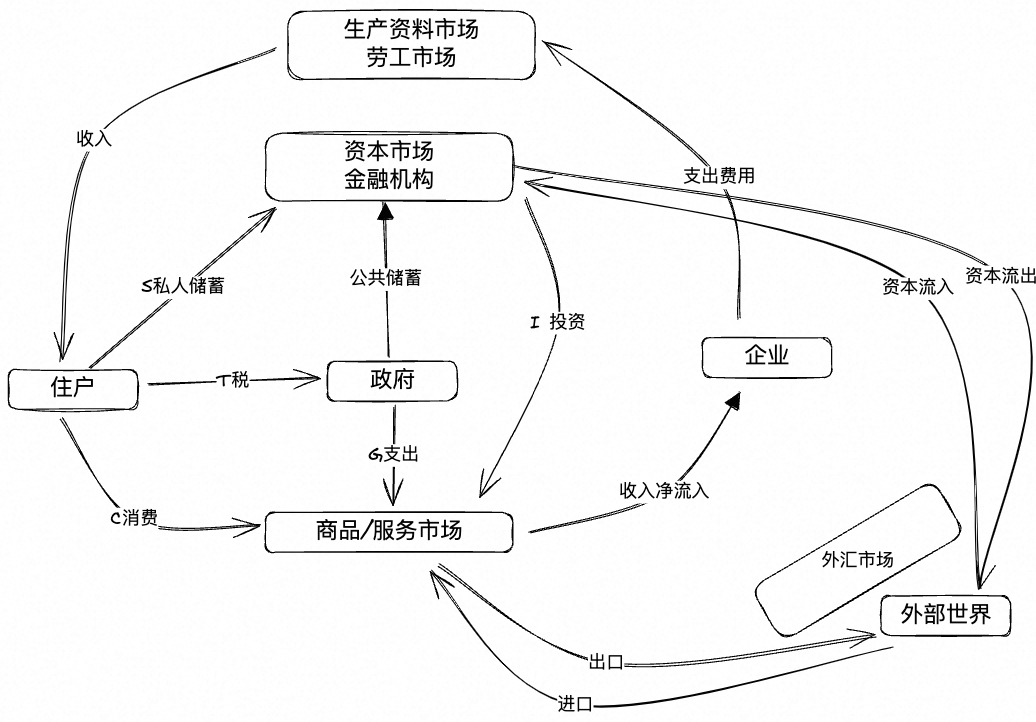
- Savings and Investment:
- Saving is managing money, while investment is putting money to use.
- Types of Investment:
- PPE (Property, Plant, and Equipment): e.g., factory equipment.
- Inventory: A high proportion in GDP indicates low efficiency (related to the “de-stocking” part of the “three reductions” policy).
- Self-built housing: Houses built by individuals or businesses.
- Services:
- e.g., service industries like healthcare and education.
2. How to Calculate GDP 🔗︎
2.1 Expenditure Approach 🔗︎
GDP = C (Consumption) + I (Investment in financial and capital markets) + G (Government spending) + Exports - Imports
2.2 Income Approach 🔗︎
GDP = Labor Income + Capital Income
2.3 The Relationship Between Savings and Investment 🔗︎
S = I (Investment by businesses in domestic financial and capital markets) + Domestic capital outflow - International capital inflow i.e., S = I + NCO (Net Capital Outflow)
2.3.1 The Role of Financial Markets 🔗︎
- Financial markets determine the interest rate (rate of return).
- Relationship between S and r: The higher the real interest rate, the more savings and the less consumption (positive correlation).
- Relationship between I and r: The higher the interest rate, the less willing businesses are to invest (negative correlation).
- Relationship between NCO and r:
- The higher the domestic rate of return, the more negative the correlation between NCO and r.
- The higher the foreign rate of return, the more positive the correlation between NCO and r.
2.3.2 Relationship between NX and Exchange Rate 🔗︎
NX = NCO An increase in the exchange rate leads to a decrease in net exports.
3. Loanable Funds Market and Foreign Exchange Market 🔗︎
3.1 Loanable Funds Market 🔗︎
- The interest rate is positively correlated with S and negatively correlated with I + NCO.
- The intersection determines the equilibrium of savings and investment and sets the interest rate r.
3.2 Foreign Exchange Market 🔗︎
- NX is negatively correlated with the exchange rate E.
- Case study of hedge funds attacking the Thai Baht:
- Borrowing and selling Thai Baht, causing capital flight and a drop in the exchange rate.
4. Balance of International Payments 🔗︎
4.1 Net Exports and Net Capital Outflow 🔗︎
- NX (Net Exports) = Exports - Imports
- NCO (Net Capital Outflow) = Capital Outflow - Capital Inflow
- NX = NCO
5. Why are Foreign Exchange Reserves Increasing? 🔗︎
NX = NCO = Exports - Imports = Chinese residents + Businesses + Central Bank (ΔForeign Exchange Reserves) - Imports Central Bank (ΔForeign Exchange Reserves) = NX + Imports - (Chinese residents + Businesses)
- NX and imports are constantly increasing, while export-related investments are subject to financial controls.
6. What is the Exchange Rate? 🔗︎
e = $/¥ How many US dollars can 1 RMB be exchanged for, i.e., foreign currency / domestic currency.
7. What is Purchasing Power Parity? 🔗︎
7.1 Purchasing Power Parity Formula 🔗︎
The cost of two baskets of consumer goods:
- Production cost in China, P_China (priced in RMB)
- Production cost in the US, P_US (priced in USD) If 100/P_China > 100e/P_US, then buy goods from China and sell them in the US. Eventually, the arbitrage opportunity disappears. The exchange rate adjusts the fastest, and prices may also change. e = P_US / P_China This is purchasing power parity.
8. What is Financial Arbitrage? 🔗︎
8.1 Interest Rate Arbitrage 🔗︎
Assume r_China (China’s interest rate) > r_US (US interest rate), then borrow USD to invest in China. Current exchange rate e0, next period exchange rate e1. Investment return formula:
- Return on investment in China: e1 × (100/e0 × (1 + r_China))
- Return on investment in the US: 100 × (1 + r_US) If e1 × (100/e0 × (1 + r_China)) - 100 × (1 + r_US) > 0, the arbitrage is successful.
9. What is the Real Interest Rate? 🔗︎
Real Interest Rate = Nominal Interest Rate - Inflation Expectation E = e × CPI_domestic / CPI_foreign e = (Foreign currency 1/6.5) / (Domestic currency 1)
- The nominal exchange rate reflects current purchasing power, but the CPI (Consumer Price Index) must be considered.
10. Why Don’t Export-Oriented Enterprises Invest Abroad? 🔗︎
- Revenue (USD) - Costs (RMB)
- Real Exchange Rate E = e × CPI_domestic / CPI_foreign
- e increases (appreciation against foreign currency), CPI_domestic increases (depreciation domestically), the real exchange rate rises.
- With USD pricing unchanged, revenue decreases, costs increase, and gross margin falls.
11. The Power of Compounding 🔗︎
- At a 10% annual growth rate, it doubles in 7 years.
- At a 7% annual growth rate, it doubles in 10 years.
12. What is Financial Repression? 🔗︎
- Nothing can fully hedge against inflation.
13. Relationship between Exchange Rates and Interest Rates 🔗︎
The interest rate can be seen as the rate of return for investing in a country. When the Fed raises interest rates, r_US > r_China, capital flows to the US, and the USD appreciates.
14. What is Goods Arbitrage? 🔗︎
Assume the price of a certain commodity is P_China in China and P_US in the US. With 100 RMB:
- You can buy 100/P_China in China
- You can buy 100e/P_US in the US If 100/P_China > 100e/P_US, then buy the commodity in China and sell it in the US to earn the price difference.
15. What is Friedman’s Theory? 🔗︎
Rational income allocation: Spend future middle-age income when young, and spend middle-age savings after retirement.
16. Why are Banks so Profitable? 🔗︎
- Banks make profits through the net interest margin (about 2.5%).
- Shadow banks (like WeBank) lend without reserve requirements; enterprises borrow from shadow banks to invest.
- Bank intermediaries recommend wealth management products, earning a spread, while users earn investment returns.
17. What is M2? 🔗︎
M2: Money Supply Δm = ΔMB × MM
- Δm: Total money supply increase
- ΔMB: Money issued by the central bank (Monetary Base)
- MM: Money Multiplier
18. The Role of Issuing Currency 🔗︎
- To avoid monetary deflation, print money.
- Measures for the central bank to withdraw funds and reduce inflation:
- Borrowing (e.g., issuing government bonds).
- Increasing the reserve requirement ratio.
19. What are Surplus and Deficit? 🔗︎
- Surplus: Exports > Imports.
- Deficit: Imports > Exports.
Market Economy 🔗︎
- There’s no such thing as a free lunch
This is the cornerstone of a market economy, revealing a fundamental truth:
- Everything has a cost. Whether explicit or implicit, acquiring and using resources requires a price to be paid.
Interpretation 🔗︎
- Resource Scarcity
- In a market economy, resources are scarce, and every choice comes with an opportunity cost.
- Acquiring one resource means giving up other possibilities.
- The Relationship Between Value and Cost
- Behind every product, service, or decision, there are hidden costs of production, time, energy, etc.
- Things that are “free” often have indirect costs, such as through advertising or data collection.
- Implications for Individuals and Society
- For individuals: Make rational decisions, weigh the pros and cons, and avoid the lure of “free”.
- For society: Understand market principles and respect the value of labor and resources.
2018 Macroeconomic Review 🔗︎
Classic Works of Marx, Engels, Lenin, and Stalin 🔗︎
Marx 🔗︎
- The Communist Manifesto
- Wage Labour and Capital
- A Contribution to the Critique of Political Economy (Preface and Introduction)
- (Appendix: Engels’ ‘On Marx’s A Contribution to the Critique of Political Economy’)
- The Class Struggles in France, 1848 to 1850
- Value, Price and Profit
- The Civil War in France
- Critique of the Gotha Programme
- Letters of Marx and Engels
Engels 🔗︎
- Dialectics of Nature (Introduction, Notes, and Fragments)
- Anti-Dühring
- (Appendix: Introduction to the English Edition of ‘Socialism: Utopian and Scientific’)
- Ludwig Feuerbach and the End of Classical German Philosophy
- (Appendix: Marx’s ‘Theses on Feuerbach’)
Lenin 🔗︎
- What Is to Be Done?
- Two Tactics of Social-Democracy in the Democratic Revolution
- Materialism and Empirio-criticism
- Conspectus of Hegel’s ‘The Science of Logic’
- Imperialism, the Highest Stage of Capitalism
- The State and Revolution
- The Proletarian Revolution and the Renegade Kautsky
- ‘Left-Wing’ Communism: An Infantile Disorder
- On Marx, Engels and Marxism
- Three Articles on War and Peace
- ‘Socialism and War’
- ‘The Military Programme of the Proletarian Revolution’
- ‘Bourgeois Pacifism and Socialist Pacifism’
- Three Articles on the National and Colonial Questions
- ‘The Socialist Revolution and the Right of Nations to Self-Determination’
- ‘Draft Theses on National and Colonial Questions’
- ‘Report of the Commission on the National and Colonial Questions at the Second Congress of the Communist International’
Stalin 🔗︎
- On the Opposition
- Problems of Leninism
- History of the Communist Party of the Soviet Union (Bolsheviks): Short Course
- Marxism and Problems of Linguistics
- Economic Problems of Socialism in the USSR
Plekhanov 🔗︎
- The Development of the Monist View of History
- On the Question of the Individual’s Role in History
- Art and Social Life (‘Letters without Address’)
New articles on AI agents, full-stack engineering, and a one-person company
I email new writing about AI and agents, full-stack engineering, and building a one-person company. No spam, and you can unsubscribe anytime.