Entrepreneurial Cognitive Thinking
If a new product doesn’t achieve a natural growth curve, we shouldn’t promote it. The foundation of a product should not be about empty talk of ecosystems and strategy. An ecosystem is not about one company doing many things, nor is it about dominating the entire industry chain. It’s about everyone being able to thrive together, with flowers and grass. - Zhou Hongyi When Jack Ma was first building China Pages, he knew he was creating something different. This belief and vision not only drove his success but also provide valuable inspiration for us today. You’re making a big bet, but the bet is on yourself. - Better Call Saul Basecamp: We have always been committed to making Basecamp a calm company. We don’t make impossible promises, we don’t chase high turnover, we don’t set deadlines, and we don’t artificially create busy work and systemic anxiety. Some projects seem to never end, and we think that’s OK.
1. Pre-sales and Productization 🔗︎
- Pre-sales: Gain early support and user trust.
- Blog Tutorials:
- Add code demonstration tools to enhance the practicality of tutorials.
- Create an MVP (Minimum Viable Product) blog tutorial based on React.
- Tech Stack:
- Develop using Node.js + TypeScript (Next.js).
- Provide recorded courses + live Q&A sessions.
2. Personal Site Planning 🔗︎
Features and Content 🔗︎
- Beginner Tutorials: Basic content suitable for beginners.
- Advanced Paid Courses: Provide in-depth learning resources to increase revenue streams.
- Ad Monetization: Integrate Google Ads to increase passive income.
Optimization Suggestions 🔗︎
- Content Refinement:
- Add more beginner-level tutorials, focusing on internationalized content (beneficial for SEO).
- User Experience:
- Add a Contact page for easy user communication.
- Display view counts on the blog to enhance interactivity.
- Drawing and Community:
- Add drawing-related content to increase user stickiness.
- Introduce Reddit articles or similar resources to practice the “Learn in Public” philosophy.
3. Blogging and Content Creation 🔗︎
Core Strategy 🔗︎
- Focus Area: Concentrate on the front-end field, referencing the paid CSDN model.
- Example: CSDN Front-end Tutorial
- Paid Validation: Test the value of knowledge through paid content.
Content Formats 🔗︎
- Videos and Scripts:
- Write a blog post or script before recording each video.
- Embed YouTube videos to enhance the multimedia experience.
- Digital Products:
- Insert links to sell courses or digital products in the blog.
- Daily Sharing:
- Record what you learn each day and share it with others through video.
4. AI Tools and Innovation 🔗︎
- AI Agent:
- Examples: aiagent.me
, askme.com
- A widget embedded in a public account that uses the power of large AI models to provide personalized Q&A services for users.
- Can we design an AI Agent based on the thinking of successful entrepreneurs to filter ideas and break down tasks? Use AI to improve entrepreneurial efficiency and innovation capabilities.
- Examples: aiagent.me
, askme.com
- AI Music Assistant:
- Train an AI to recommend music that matches personal preferences.
- AI Book Reader:
- Summarize the content of PDF files and generate short video summaries.
- Leverage the free quota of a PC desktop client.
5. Learning and Cognitive Methods 🔗︎
The Feynman Technique 🔗︎
- Core Idea: Learn to talk to yourself to understand things you don’t know.
- Practice: Test your own mastery by explaining it to others until they understand.
ABCDE Cognitive Method 🔗︎
- A (Activating Event): What happened?
- B (Belief): How do you view this event?
- C (Consequence): What emotions did this event cause in you?
- D (Disputation):
- How did this event help me?
- What are the benefits of each communication?
- Does each change help things develop in a positive direction?
- E (Effect): Rethink the pressure from others and your communication mindset to build a good emotional bank account.
6. Be Proactive 🔗︎
- Take Responsibility:
- Be responsible for yourself and don’t blame problems on the environment or others.
- Power of Choice:
- Believe that you always have the ability to choose how to respond.
7. Entrepreneurial Inspiration and Execution 🔗︎
Sources of Inspiration 🔗︎
- Find inspiration from platforms like forums, YouTube, and Twitter.
- Create products and services by combining personal traits (such as a front-end engineer’s technical skills, resources, and information gap).
Recent Ideas 🔗︎
- ChatGPT-Assisted Creation:
- Use ChatGPT to gather information and generate summary briefings to decide on the day’s video topic or writing content.
- Amazon eBook Market:
- Create picture book stories and publish them on the Amazon eBook market.
- Internationalization Capability:
- Includes the international layout of blogs and video blogs (like YouTube, Bilibili, Douyin).
8. Other Resources and Subscriptions 🔗︎
- Subscription Model:
- Combine free + paid subscriptions, for reference: TechWorld Newsletter
- Community Management:
- Add a Telegram community ID to the blog or knowledge-sharing platform to facilitate user communication.
- Technical Barriers:
- Create high-tech products to form a competitive barrier.
- Create high-tech products to form a competitive barrier.
Forward-Thinking: Foresee the Future, Solve Problems 🔗︎
Over-pursuing how to best solve one problem, while ignoring a more important point—solving more problems.
- Core Viewpoint
- One must have forward-thinking to anticipate problems and prepare in advance.
“Some problems are solved during the course of development.”
- Many problems do not need to be solved immediately but are naturally resolved in the process of development.
- Key Points
- Forward-thinking is a capability that helps you seize opportunities and avoid risks in complex environments.
- Learn to look at problems from a long-term perspective and avoid being constrained by immediate difficulties.
Sales Acquiring the First Batch of Users: Starting with Xiaoyuan Souti 🔗︎
Human Nature 🔗︎
- You can always make money by leveraging human nature.
- The desire and pursuit of certain concepts in human nature are often used to guide consumption or behavior.
- Case Study: Learning English
- Society has instilled the concept that “learning English is the key to success,” leading people to flock to English learning.
- Case Study: School District Housing
- After the concept of education was reinforced, the demand for school district housing became fanatical.
- How to understand human nature?
- Observe people’s behavior patterns and analyze the driving forces behind them.
- Think: Why are certain concepts widely accepted? How do these concepts influence mass behavior?
1.1 The Starting Point of Advertising 🔗︎
- Xiaoyuan Souti’s Advertising Strategy: The first batch of users was acquired by placing ads on Xiaoyuan Souti. This precise ad placement helped the product quickly reach its target user group.
- Significant Effect: This method was not only low-cost but also quickly accumulated seed users, laying the foundation for future development.
1.2 The Turning Point in User Growth 🔗︎
- The Process of Being “Played Out”: As the number of users grew, some user behaviors gradually deviated from the product’s original intention, affecting the user experience and brand image.
- Reflection and Adjustment: This stage exposed the product’s shortcomings in user management and operations, prompting the team to re-examine user needs and optimize product features and rules.
2. The Rise of Douyin: The Birth of the First Influencers 🔗︎
2.1 The Necessity of Self-Operation 🔗︎
- Initial Cold Start Problem: In the early days of Douyin’s development, there were almost no active users on the platform, let alone so-called “influencers.”
- Taking the Initiative: To break the deadlock, the Douyin team chose to operate the first batch of influencers themselves, creating content through internal employees or partners to drive the platform’s atmosphere.
2.2 The “If No One Plays, Play It Yourself” Spirit 🔗︎
- Leading by Example: The Douyin team personally participated in content creation, proving the platform’s value and potential through practical actions.
- Demonstration Effect: These officially supported content creators became role models for other users, inspiring more people to join the ranks of creators.
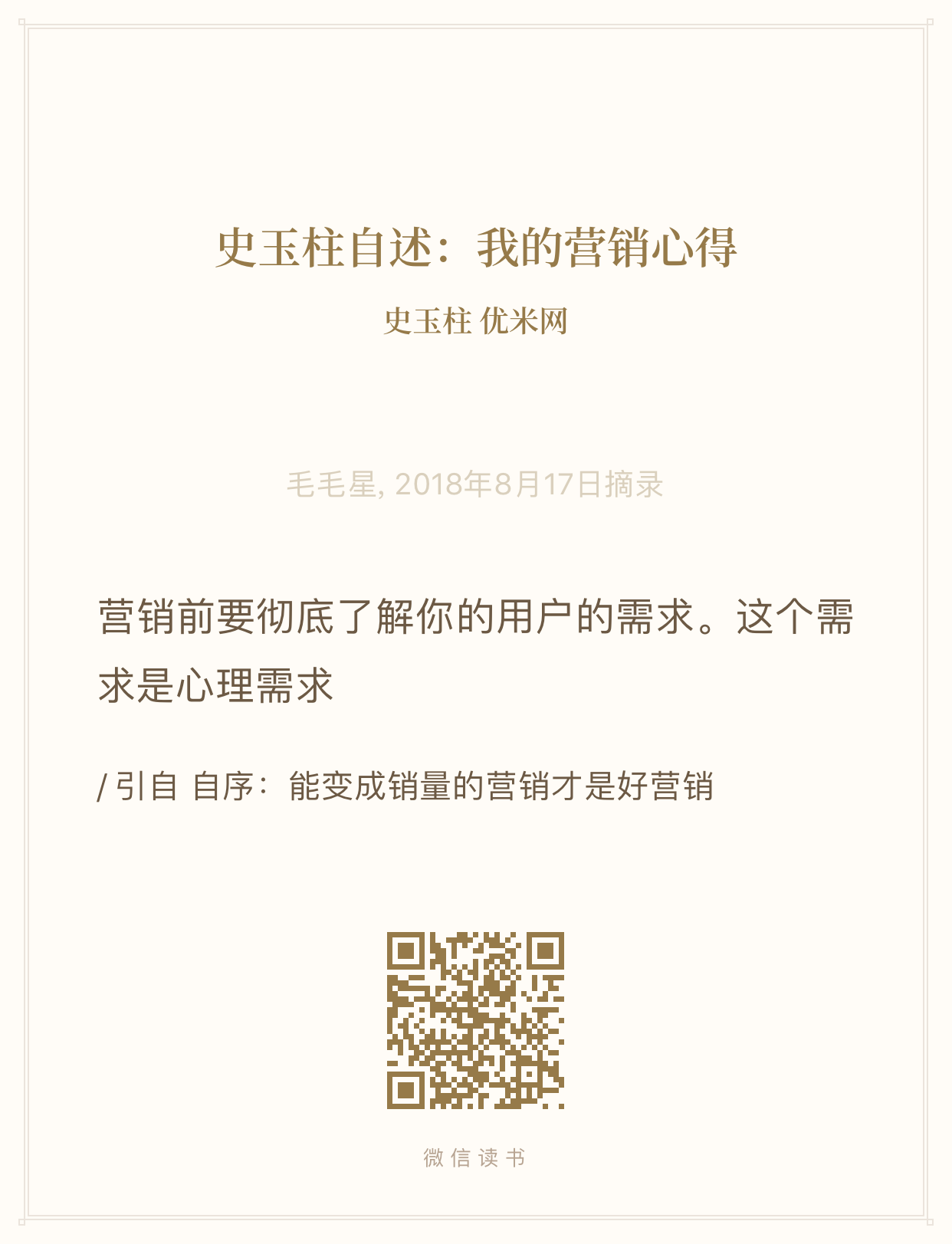
Summary from reading Shi Yuzhu’s autobiography:
1. Marketing: Figure It Out Yourself, Find a Unique Path 🔗︎
- Independent Exploration: There is no fixed formula for marketing. You must figure out a suitable strategy based on your own product, market environment, and target user characteristics.
- Innovative Thinking: Avoid blindly imitating others. Find a differentiated marketing approach to stand out from the competition.
- Data-Driven: Continuously optimize marketing strategies through data analysis to ensure every step is based on actual results rather than subjective guesses.
2. Entrepreneurship: Focus on One Direction, Execute Firmly 🔗︎
2.1 Focus on One Direction 🔗︎
- Focus on Core Business: Entrepreneurial resources are limited, so you must concentrate your efforts on one direction to avoid distraction.
- Clear Goals: Clearly define the company’s mission and vision to ensure all efforts are centered around this goal.
2.2 Democratic Decision-Making, Firm Execution 🔗︎
- Democratic Decision-Making: When formulating strategies, fully listen to the team’s opinions to ensure decisions are scientific and reasonable.
- Firm Execution: Once a decision is made, push forward with all your might and do not easily waver or change direction.
- Rapid Iteration: Maintain flexibility during execution, adjust details in a timely manner, but always adhere to the core goals.
3. Team Building: Select People Who Are “Red and Expert” 🔗︎
3.1 “Red”: Value Alignment 🔗︎
- Cultural Fit: Choose talent that identifies with the corporate culture and values to ensure team cohesion.
- Strong Sense of Responsibility: Prioritize candidates with a strong sense of responsibility and mission, as they are more willing to strive for common goals.
3.2 “Expert”: Strong Professional Skills 🔗︎
- Skill Match: Ensure team members have the professional skills required to complete their job tasks.
- Continuous Learning: Encourage team members to continuously improve themselves to adapt to the rapidly changing market environment. As a telemarketer, the key to success lies not only in the product itself but also in the way you convey information and your attitude. Here are some suggestions on how to win over customers with your voice and mindset.
1. Mindset Adjustment: Confidence and Composure 🔗︎
1.1 The “Bills Are Paid” Mindset 🔗︎
- Psychological Suggestion: Before making a call, tell yourself, “The bills are paid.” Regardless of the outcome of this call, your life will not be affected.
- A Real Sense of Ease: Speak in a relaxed, natural tone, as if this deal is unimportant to you. For example:
- “I don’t actually need this money.”
- This attitude will make the customer feel your confidence, not pressure.
1.2 Be Hopeful for the Future 🔗︎
- Positive Emotions: Let the customer feel your optimism and anticipation for the future. For example:
- “After this call, I’m ready to jump into my Ferrari.”
- Even if you don’t have a Ferrari, this positive attitude will infect the customer and make them feel that talking to you is a pleasant experience.
2. The Charm of Your Voice: Become the Voice Others Wish They Had 🔗︎
2.1 A Confident and Warm Voice 🔗︎
- Tone Control: Maintain a moderate speaking speed, with a clear and rhythmic voice. Avoid a tone that is too rushed or monotonous.
- The Power of a Smile: Even if the customer can’t see your expression, smiling will make your voice sound warmer and more approachable.
2.2 Become a Role-Model Voice 🔗︎
- Goal: Make your voice the one that customers wish they had. For example:
- Firm but not aggressive.
- Warm but professional.
- Practice Method: Record and listen to your own voice to identify areas for improvement.
3. Practical Skills: How to Be at Ease on the Phone 🔗︎
3.1 Designing Your Opening 🔗︎
- Example:
- “Hello, this is [Your Name]. I’m calling today to share an opportunity that could be very valuable to you.”
- Note the relaxed tone; don’t make the customer feel pressured.
3.2 Handling Rejection 🔗︎
- Composed Response: If a customer says no, respond in a calm tone:
- “I completely understand. If you have any needs in the future, feel free to contact me.”
- Don’t show disappointment or frustration; remain professional and polite.
3.3 Reinforcing Trust 🔗︎
- Language Skills: Use positive language and specific examples to enhance persuasiveness. For example:
- “Many of our clients have reported that this solution has helped them save a significant amount of time and money.”
The copy for a product must be communicable or newsworthy. Let other people discuss it: for example, “the best phone in the Eastern Hemisphere” is very important. Entrepreneurs must be careful. Especially in front of the media. Differentiated things are what create competitiveness.
Design 🔗︎
In product design, advertising, and user communication, “Less is More” is a golden rule. The following content, based on simplicity, user perspective, and practicality, will help you better understand and apply this concept.
1. Less is More: The Simpler, The Better 🔗︎
1.1 The Power of Simplicity 🔗︎
- Reduce Cognitive Load: Users have limited time and attention. Overly complex designs or information can make them feel tired and even give up.
- Focus on Core Value: Remove redundant elements and highlight the most important functions or information so users can quickly understand and take action.
- Balance of Visuals and Content: Whether in interface design or copywriting, strive for clarity, intuitiveness, and efficiency.
1.2 Practical Advice 🔗︎
- Concise Copy: Use the fewest words to express the clearest meaning. For example, simplify “Click here for more information” to “Learn More.”
- Optimize Flow: Reduce the number of steps for the user, ensuring each step directly serves the goal.
- Avoid Over-design: Don’t sacrifice functionality for aesthetics. Keep the interface clean and tidy.
2. Imagine the User as Very Stingy, with a Low IQ, and a Bad Temper 🔗︎
2.1 The User’s Mental Model 🔗︎
- Stingy: Users are unwilling to waste time, money, or energy. Your product must provide clear value to make them willing to invest.
- Low IQ: Assume the user knows nothing about your product. Avoid using jargon or complex logic.
- Bad Temper: Users have no patience to study your product. If they feel confused or frustrated, they might leave immediately.
2.2 Coping Strategies 🔗︎
- Lower the Barrier to Entry: Make the product easy to understand and use, so even “zero-basis” users can get started quickly.
- Instant Feedback: Provide clear feedback during user operations to prevent them from feeling lost or uncertain.
- Emotional Management: Alleviate users’ negative emotions through a friendly tone, thoughtful design, and efficient solutions.
3. Useful + Advertising: Value-Driven Communication 🔗︎
3.1 Provide Real Value 🔗︎
- Solve Pain Points: The core of advertising is to tell users what problems your product can solve, not just to sell.
- Actual Benefits: Emphasize the specific benefits of the product, such as saving time, reducing costs, or improving efficiency.
- Case Proof: Enhance persuasiveness with real user stories or data.
3.2 Simplicity in Advertising 🔗︎
- Explain in One Sentence: Ad copy should get straight to the point, for example, “Learn a new skill in just 5 minutes a day.”
- Visual Impact: Use simple graphics or colors to attract attention, but don’t let them overshadow the main message.
- Call to Action: Clearly tell the user what to do next, such as “Sign Up Now” or “Free Trial.”
The Work 🔗︎
- Core Viewpoint
“You can throw money, resources, and channels at it, but the foundation of communication will always be strategy and creativity. If this isn’t solved, more money is useless.”
- Key Points
- While resources and channels are important, without a good strategy and creativity, no amount of investment will be effective.
- Creativity is the foundation of communication, the bridge that connects brands and consumers.
2. The Meaning of the Work: A Way to Communicate with the World 🔗︎
- The Essence of the Work
- A work is not just the product itself, but the creator’s way of communicating with the world.
- It is an attitude, an expression, a unique interpretation of the world.
- The Artisan Spirit
- Being an artisan means slowness, small quantities, and labor, backed by a pursuit of focus, skill, and perfection.
- Core Philosophy: Focus on making something to be worthy of the time and years.
3. Consumer Insight: Building Scenarios and Psychological Sketches 🔗︎
3.1 Building Scenarios that Connect Consumers with Products 🔗︎
- Why is it important?
- Consumer purchasing behavior often occurs in specific scenarios.
- The core task of advertising is to uncover these scenarios and resonate with consumers.
- How to build scenarios?
- Analyze the consumer’s lifestyle: What car do they drive, what house do they live in, what do they eat?
- Explore their psychological characteristics: What do they care about? Under what circumstances will they connect with the product?
3.2 The Consumer’s Social Attributes and Psychological Insights 🔗︎
- Sketching the Consumer
- Don’t just focus on demographic characteristics (age, gender, income, etc.), but also deeply understand their social attributes and psychological needs.
- Key Point: When you can clearly “draw” a picture of the consumer, the copy will naturally emerge.
4. Functional Copywriting and Marketing Illusions 🔗︎
4.1 Functional Copywriting (Y-type Copy) 🔗︎
- Characteristics
- Like a detective, meticulously find the product’s Unique Selling Proposition (USP).
- On this basis, integrate a powerful purchasing motive and present it to the consumer.
- Methodology
- Analyze facts, refine selling points, and design a persuasive logic.
4.2 Marketing Illusions: The Control of Emotion and Mood 🔗︎
- Core Viewpoint
“How to use persuasion in a world where facts are fundamentally unimportant.”
- Humans are often only “self-proclaimed rational,” while the essence of marketing is the control of emotion, mood, and spirit.
- Metaphor: Marketers are hypnotists who create illusions, influencing consumer behavior by creating emotional connections.
5. Idea Generation: The Limitations of Group Brainstorming 🔗︎
- The Fallacy of Group Brainstorming
- Many teams like to use group brainstorming to spark creativity, but in reality, this method is often inefficient.
- Observation: Group brainstorming is usually only useful when receiving requirements or reviewing a brief; at other times, it can be a waste of time and energy.
- A Better Way
- Encourage individual independent thinking and deep dives into consumer insights.
- After a clear direction is established, then conduct small-scale discussions and optimizations.
New Oriental Case Study: 1. Entrepreneurial Investment and Focus 🔗︎
- Full Commitment
“To build a publicly listed company, a total of one or two hundred million US dollars might not be enough. He said if I invest everything, someone will definitely join me.”
- Entrepreneurship requires a full-fledged effort. Especially with limited resources, the founder’s determination and investment are crucial.
- Focus on Future Trends
- Characteristic: For anything I don’t understand but believe is highly relevant to future development, I will dive in and research it.
- Case Study: Artificial Intelligence
- Although New Oriental seems to have no direct connection to artificial intelligence, Yu Minhong conducted in-depth research in the field, believing that technology is a means to achieve educational goals, not the goal itself.
- Core Viewpoint: The role of artificial intelligence in education is to increase students’ interest and efficiency in learning, not to replace the essence of education.
2. The Core of Entrepreneurship: Industry Cognition and Product Polishing 🔗︎
2.1 Deeply Understand the Industry 🔗︎
- Prerequisite for Entrepreneurship
- To start a business, you must understand the industry. Only by deeply understanding the industry’s rules can you find a breakthrough.
- Case Study: New Oriental and Artificial Intelligence
- New Oriental uses artificial intelligence technology to optimize the educational experience, helping students learn more efficiently.
- Key Point: Technology is a tool; the goal is to serve user needs.
2.2 Polishing High-Quality Content 🔗︎
- The Path to Success for a Product Company
- If you are a product company, it means you must perfect the product to an extreme degree, making it highly aligned with human nature, to attract repeat purchases.
- The Importance of High-Quality Content
- Polishing high-quality content takes time and patience.
- Case Study: Uncle Kai Tells Stories
- Uncle Kai’s meticulous polishing of his product is admirable: 4 hours of recording are edited down to just 20 minutes of content.
- This dedication to detail has attracted over twenty million child users to “Uncle Kai Tells Stories.”
- Investment Preference
- Summary of Experience: It’s best not to invest in projects with several partners; a project with a single founder is more likely to succeed.
- Reason: A single founder can more easily maintain consistency in decision-making and execution.
3. Facing Challenges and Crises 🔗︎
3.1 The Attack from Muddy Waters 🔗︎
- Event Background
- In 2012, New Oriental was attacked by the US firm Muddy Waters, which published an exposé based on data analysis, questioning New Oriental’s financial situation.
- Countermeasures
- Hired the world’s most famous law firms and audit firms to prove New Oriental’s innocence.
- Eventually regained the trust of the US Securities and Exchange Commission.
- Lesson
- Core Viewpoint: When facing a crisis, a transparent and professional response is key.
4. Growth and Change 🔗︎
4.1 Expanding Breadth of Mind and Personality 🔗︎
- The Necessity of Growth
- It depends on whether you are willing to constantly change. Your breadth of mind can be expanded, and your personality can also be changed.
- Difficulty: Expanding one’s mind and changing one’s personality is not easy, but it is the key to continuous growth.
- Reflecting on Success and Failure
“Any trait that made you successful in the past could become the reason for your failure.”
- Successful experiences can become future constraints. Entrepreneurs need to be constantly vigilant and adjust their thinking patterns.
Two Stages of Business Strategy
Phase 1: Conversion 🔗︎
- Core Objective
- Determine which benefits can be packaged for users to increase the user conversion rate.
- Key Points:
- Analyze user needs, select high-value, highly attractive benefits.
- Design benefit packages to maximize perceived user value.
Phase 2: Scaling 🔗︎
- Core Strategy
- First, charge a 30% channel fee, which has a higher profit margin compared to a 0% revenue share model.
- Advantages:
- Lock in profits early, reducing risk.
- Maintain a healthy financial model during large-scale expansion.
1. The Importance of Industry Selection 🔗︎
- Core Viewpoint:
- The industry determines success or failure: No matter how excellent you are, if the industry you are in is not good, your probability of success will be limited.
- Good Industry vs. Bad Industry:
- Being ranked 100th, 10th, or even 20th in a good industry is more valuable than being first in a bad industry.
- The difference in industry has a huge impact on the development of individuals and teams.
- Case Study:
- In 2008, the most profitable industry was SP (Service Provider), so choosing the right industry is crucial.
- Remember: The foundation of the industry determines the probability of success.
2. Short-term Thinking vs. Long-term Thinking 🔗︎
- Short-term Thinking:
- Executives in large companies often tend to “think short-term,” which means solving problems by obtaining resources from the company and reporting with PPTs to their leaders.
- This method focuses on short-term benefits and neglects long-term development.
- Long-term Thinking:
- The core of the long-term approach is to solve the problems of the product itself, focusing on the product’s long-term value and user experience.
- Case Studies:
- Back then, I told my team: “Children from poor families mature early. I’ll give you 100,000 yuan to go for it.”
- Although 100,000 yuan is not a lot, it can stimulate the team’s creativity to find a real product breakthrough.
- When Lei Jun founded Xiaomi, he told Lin Bin: “We have no budget for marketing.”
- This reflects their focus on the product itself, rather than relying on external resources.
- Back then, I told my team: “Children from poor families mature early. I’ll give you 100,000 yuan to go for it.”
3. Common Problems in Product Development 🔗︎
- The Trap of Empiricism:
- Every team and individual has their own experiences, which can lead to stubbornness.
- Example:
- Endlessly struggling over details like color schemes, layout, and typography, wasting time and energy.
- If discussions are ineffective, you must reflect: Is there a problem with the basic principles and basis of the discussion?.
- How to Avoid Falling into Traps:
- Find the real pattern: If you find the pattern of product development, you will see the product grow “exponentially.”
- The key is to break out of fixed thinking and avoid pointless arguments.
4. User Needs and Product Patterns 🔗︎
- The Essence of User Needs:
- We often think we understand users, but in reality, truly understanding users is the hardest thing.
- Case Study:
- I once asked a store clerk: “Why do you think this antivirus software is good?”
- The clerk replied: “After this software scans, if you scan again and it finds a new virus, then it’s good antivirus software.”
- Users’ understanding is often very simple, and their needs may be simpler than we imagine.
- I once asked a store clerk: “Why do you think this antivirus software is good?”
- How to Grasp the Patterns:
- Spend time communicating with users face-to-face to deeply understand their needs.
- Only by truly understanding users can you grasp the patterns of product development.
Business Concepts 🔗︎
Platform Value: cpc/cpm(cost per mille)/average consumption PVR, is a ratio that represents the utilization rate of traffic Merchant Value: RPM, revenue per mille (thousand impressions) Channel Type: PPC, is a keyword marketing method where businesses pay to purchase specific ad placements on search engines, the PPC billing method is pay-per-click,
Delivery 🔗︎
Delivery Process: Technology - Product - Business Site Dimensions Feature Configuration (Home Edition/Professional Edition): Configuration is controlled by technology. Later, it will be split into what is controlled by technology and what is controlled by product/business.
Traffic Tiering 🔗︎
Social Traffic (monetization relies on activity, i.e., high frequency) Information Traffic (exclusivity) Scenario Traffic (easily replaced) Business Direction Lead (the one who deals with users)
New articles on AI agents, full-stack engineering, and a one-person company
I email new writing about AI and agents, full-stack engineering, and building a one-person company. No spam, and you can unsubscribe anytime.