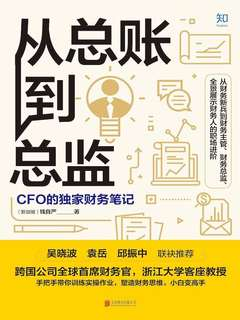
From General Ledger to Director
- My rating: 5 / 10
- Purchase Link
This book, set against a financial backdrop, tells the story of a person’s growth from a novice in the workplace to a manager. It not only covers financial knowledge but also provides rich workplace competency models, relationship models, and management models to help readers enhance their personal skills, optimize interpersonal relationships, and master management techniques.
Comprehensive and Practical Content: The book includes various skill models needed for career growth, making it suitable for professionals at different stages of their careers.
Rich Cases: Through specific scenarios and tools (such as the Six Thinking Hats, Balanced Scorecard, etc.), making the theory easier to understand and apply.
- Clear Logic: The three major modules—competencies, relationships, and management—are well-structured and progressively build upon each other, facilitating systematic learning.
- Some Content Slightly Repetitive: Explanations of certain models could be more concise to avoid redundancy.
What I Liked 🔗︎
- Lack of Practical Details: The actual operation steps for some tools and methods are not detailed enough, possibly requiring supplementary resources.
Capability Model: Building Core Competitiveness 🔗︎
1. Key to Rapid Growth 🔗︎
Visibility > Relationships > Capability: Performing in key situations (such as presentations, demonstrations) is more important than mere capability.
Capability expands relationships, relationships bring opportunities: Capability is the foundation, but relationships and opportunities are the accelerators for growth.
What I Disliked 🔗︎
- Activation Order of Management Abilities: Management responsibilities are only granted after the ability reaches a certain level.
2. Focus Circle and Influence Circle 🔗︎
- Focus on the Influence Circle: Concentrate your energy on things you can change. The results of this focus will gradually expand your influence circle.
3. Dynamic Thinking vs. Static Thinking 🔗︎
Key Takeaways 🔗︎
- Belief fosters change, doubt halts progress: Viewing problems with a dynamic mindset helps drive progress.
4. Critical Thinking and Categorization Skills 🔗︎
- Categorization is the first key to solving complex problems: Organize information through tables, charts, and other methods to build a knowledge base.
- Data -> Information -> Message: The core presentation is the message, followed by information explanations, and finally data support.
5. Pulled Learning 🔗︎
- Learner-Centered: Allow learners to choose courses, ask questions, and have mentors provide guidance rather than direct answers.
6. OCA Model and Value Orientation Diagram 🔗︎
- Open-Minded Thinking: Provide options and comparative plans to assist in decision-making.
- ATM Job Value Model: Clarify the workflow and identify value points.
7. Presentation Skills 🔗︎
- Start from the outside, end in mind: Begin with the audience’s needs, avoiding self-centered perspectives.
- Capture attention in 5-7 minutes: Structure your delivery to ensure key messages stand out.
8. The 3R Model and the Six Thinking Hats 🔗︎
- 3R Model: Memorize the outline, practice with examples, and activate memory to prepare for potential questions in advance.
- Six Thinking Hats: Analyze problems from multiple perspectives (objective, emotional, disadvantages, advantages, creative, and control).
9. Simple Thinking and Digital Thinking 🔗︎
- Digital Thinking: From data modeling to behavioral assumptions, forming a model to solve problems.
10. Influence Model 🔗︎
- Professional Value Information vs Noise: Good influence comes from professional value, not meaningless interference.
Relationship Model: Building an Efficient Interpersonal Network 🔗︎
1. Three Professional Personality Colors 🔗︎
- Red: Goal-driven, prone to causing friction.
- Green: Focuses on rationality but may overlook goals.
- Blue: Emphasizes atmosphere and relationships, high emotional intelligence.
2. Schrödinger’s Cat and Superposition 🔗︎
- Each person’s personality is not singular but exists in a superposition of multiple states.
3. Emotional Bank Account 🔗︎
- Deposits: Attending meetings on time, expressing concern, proactively offering help.
- Extraction: Use in critical moments, avoid abuse.
4. Communication Order and Leaving for Lunch 🔗︎
- Communication Order: Prioritize communicating with those closest to you, observe body language and emotions.
- Leaving for Lunch: A channel to obtain important information.
5. The Art of Feedback 🔗︎
- Be Immediate, Specific, and Focus on Behavior, Not People: Focus on the motives behind workplace behavior (VBI), create a positive atmosphere, listen and show vulnerability, and express objectively.
6. Key Considerations for Cross-Level Communication 🔗︎
- Avoid expressing personal opinions to prevent being set up.
Management Model: Enhancing Team Efficiency 🔗︎
1. Balanced Scorecard Model 🔗︎
- Measuring the four dimensions of corporate management effectiveness: performance, customer satisfaction, internal processes, and employee development.
2. Leverage Thinking 🔗︎
- Operating leverage: From promoting a single experience to a brand or technology.
- Capital Leverage: Professional competence in financial management.
- Resource Leverage: Organizational Competitiveness.
3. Three Basic Skills of Managers 🔗︎
- Task Management: Distinguish between goal decomposition and task definition, focus on leading indicators.
- Feedback: Timely, specific, objective.
- Time Management: The Eisenhower Matrix, prioritize important tasks.
4. Engage Stakeholders 🔗︎
- Empathy Ability: Start from the other party’s KPI to turn observers into participants.
5. Value Chain Cooperation and Win-Win 🔗︎
- Partners are like bees, bringing continuous value while also drawing nourishment. The key is to share experiences with each other.
6. The 3M Model for Retaining Talent 🔗︎
- Meaning(意义): Find the meaning of work through the project.
- Menu(自主学习): Provide direction, encourage self-growth.
- Mentor(导师): Offer guidance, assist in development.
7. Time Management Four Quadrants 🔗︎
- Priority Principle for Major Stones: Lock in important matters in advance to reduce fire-fighting type work. 《From General Ledger to Director》 is not just a book about finance, but also an encyclopedia of career growth. Through learning in the three major modules of ability, relationships, and management, we can comprehensively improve personal competitiveness, optimize team collaboration, and achieve leaps in career development.
Do ordinary people need to master these models?
Whether you are a new employee in the workplace or a manager, these models can help you better understand workplace rules, improve efficiency and influence, and thus stand out in the competition.
New articles on AI agents, full-stack engineering, and a one-person company
I email new writing about AI and agents, full-stack engineering, and building a one-person company. No spam, and you can unsubscribe anytime.